


With the promise of a large, demographically diverse audience, the Games of the XXXII Olympiad — the pandemic-delayed 2020 Tokyo Olympics — are forecast to bring in record-high advertising revenue.
In fact, Kantar believes the ad dollars will be more than 20% higher than the 2016 Summer Olympics in Rio de Janeiro.
With the numbers crunched and analyzed, Kantar believes “Tokyo 2020” — which begins Friday, July 23, 2021 and concludes August 8 — could reach $2.25 billion in U.S. ad revenue for the “live” broadcast.
That’s more than 20% higher than the 2016 Summer Games and suggests an all-time high.
Tokyo is 13 hours ahead of New York, which suggests prime-time telecasts could indeed be live. In a social media world where results are instantaneous, thus diminishing tape-delayed telecasts, that’s a great thing.
But, the delayed games still have some worried about audience passion. With all events restricted from public attendance due to continued COVID-19 concerns in Japan, some media observers have gone so far as to question how NBCUniversal’s NBC Sports and Telemundo Deportes teams can fully produce their respective Tokyo Olympics coverage.
Those concerns may be muted by Madison Avenue and brand managers, plus media buyers, who crave a live “must see now” opportunity for products and services eager to jump start their marketing and reinvigorate sales.
Still, Kantar found that despite the postponement from 2020, 53% of U.S. consumers agree the games should be postponed or cancelled. That’s according to a Express Survey conducted on Kantar Marketplace late last month.
Additionally, some 37% of respondents aren’t interested in watching coverage of the Tokyo Olympics.
Given this uncertainty, brands who are advertising during or sponsoring the Games will need to exercise caution, Kantar SVP of Brand and Marketing Satya Menon notes. “Many Olympic sponsors are hastily adjusting to the ever-changing narrative around the Tokyo Olympics,” Menon says. ”Brands are rightly concerned about optics, and need to carefully adjust the tonality of their communication, keeping in mind that in much of the world, consumers are stressed, angry and less hopeful due to the pandemic.”
NBC has enjoyed Olympics telecast rights since 1988, attracting advertisers from every sector interested in negotiating substantial packages. The Summer Olympics, especially, has been a cornerstone event, with its larger range of country participants and more popular games increasing viewership.
Digital and streaming viewing as well as ad spend are also growing, but broadcast television continues to make up the majority of spend, Kantar finds.
A MINOR DIP DUE TO POSTPONEMENT
The postponement of Tokyo 2020 to 2021 may result in some reductions to the total ad spend. But, says Kantar, major declines seem unlikely. “First, much of this ad spend was already committed prior to the pandemic, with NBC stating it had already sold $1.25 billion in advertising by March 2020,” it notes. “Second, event sponsors like Coca-Cola, VISA and Procter & Gamble Co. have continued their support for the IOC and the Games.”
This loyalty is understandable, notes Gregory Aston, Head of Media Research and Data Science at Kantar. “While brands are expected to cautiously navigate the concerns of COVID surrounding the Olympics, the games remain an enormous tent pole event that can significantly stimulate a brand’s rebound in second half,” Aston said. “I expect the benefits of such an event will outweigh the risks for many brands looking to build momentum in their recovery strategy.”
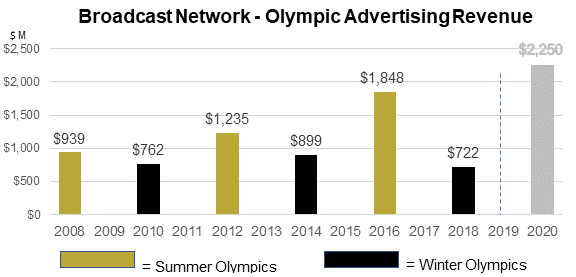
Even with the year delay and continued COVID-19 concerns, the Olympics remain the single most valuable sporting event for broadcast networks, Kantar finds.
While ad rates are much higher for the Super Bowl, less inventory is available for the one-night event, which reached $485 million in ad revenue this year.
In the two weeks from Opening to Closing Ceremony, the Olympics generates 10% to 15% of total annual Sports revenue across all broadcast networks. This includes Baseball, Basketball, Football, Hockey, Tennis and all of other major broadcast events.
“The sheer size and importance of the Olympics is unmatched in the sports genre,” Kantar concludes.
A BROAD ADVERTISER RANGE
The mix of advertisers contributing to the Olympics’ billions of dollars in spend is worth a look, especially for NBC affiliates looking to attract advertisers with local avails.
Automotive, Communications and Financial categories represent the highest spenders. Interestingly, the Insurance and Motion Picture categories scaled back their presence during the 2018 Olympics, only to be filled by Electronics and Restaurants. Meanwhile, several of these categories – including Travel & Hospitality, Motion Pictures and Restaurants – reduced ad spend significantly in 2020 due to the pandemic.
Kantar believes these sectors could double down on spend this year as they look to lure consumers back. However, it remains to be seen how enthusiastic fans will be about this year’s unique Olympic games, Kantar says.
Share of Olympics Ad Spend by Category, 2016 and 2018
| Category | 2016 Olympics | 2018 Olympics |
| Automotive | 21% | 18% |
| Communications | 12% | 13% |
| Financial | 7% | 8% |
| Electronics | 1% | 8% |
| Restaurants | 6% | 7% |
| Insurance | 8% | 6% |
| Motion Pictures | 7% | 6% |
| Corporate Image | 2% | 5% |
| Beverages | 5% | 5% |
| Travel & Hospitality | 2% | 4% |
| Subtotal: | 71% | 78% |
| All Other | 29% | 22% |
Source: Kantar Advertising Insights