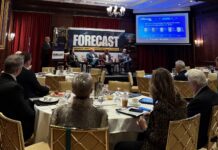
MIAMI BEACH, FLA. — Reach. It’s the magic word for broadcast television in a world where over-the-top (OTT) delivery of video content is gaining more and more attention on a global level.
As S&P Global Market Intelligence Senior Research Director Robin Flynn sees it, broadcast TV’s future — at least in the next few years — remains bright. At the same time, she admits, “It is healthy. It is challenged.”

Flynn’s comments came not at NATPE Miami, winding down at the Fontainebleau resort hotel, but next door amid construction noise at the Nobu Eden Roc — host to the Matrix Solutions Media Ad Sales Summit.
The more intimate gathering of radio and TV industry professionals including Frank Friedman, VP/Local Media of The E.W. Scripps Co. and a former Publicis ad agency executive, kicked off with Flynn participating in a Q&A with Tim Hanlon, CEO of The Vertere Group.
As Flynn sees it, broadcast media is not just one industry anymore. “It is an industry that is very fragmented, and one that has broad reach for broadcasters and narrow reach for streaming.”
While there’s now a “tremendous ability” for targeting, something brand managers and CMOs crave more and more, “the broad interest in broadcasting hasn’t gone away,” Flynn observes.
Case in point: Some $3 billion in political advertising was seen in 2018.
Flynn also notes that while live sports and news is seen as broadcast TV’s two biggest assets, scripted programming and dramas continue to drive audiences.
THE AD OUTLOOK
In a political year, “there’s a lot of crowd-out” of traditional ad categories, Flynn remarks.
This year’s outlook: “It’s flattish … it’s not horrible, but not great,” she says.
And, when it comes to surprises regarding core advertising, the surprise is when pacing is down, rather than up.
Where are some of the key core categories heading in 2019?
Automotive, Flynn notes, “has been very bumpy and very brand-dependent, and that changes. One year, there is more on local, and there are some that aren’t [doing more on local].”
This year, there are four key concerns with respect to automotive sales: tax reform, tariffs, the general economy and even the partial government shutdown.
But, some advertisers are trying TV — Flynn points to Nexstar Media Group as one company bringing in new clients — and seeing positive results.
On a national level, pharmaceutical brands are strong. But, that hasn’t translated to local growth.
As such, local needs to explore ways to keep the dollars in odd years strong. “It would be great if political were Core, but there’s no getting away from that,” Flynn notes.
ON TARGET
Hanlon wondered if there are specific advantages for cable or satellite with respect to their ability to target. Can broadcasters deliver targeted advertising through OTT streaming or ATSC 3.0, the much-heralded next gen broadcast TV standard?
The word Flynn used to describe the situation is “murky.”
She says, “ATSC 3.0 always seems to be several years away.” As such, the OTT advantages and advancements are more immediate for broadcast TV to take advantage of, giving them the targeted ability so many advertisers now seek.”
While addressable advertising is coming — some day — broadcast TV’s biggest attraction point will remain what it is today, Flynn says.
“In terms of reach, broadcast is still key,” she concludes, “and it will stay the case.”